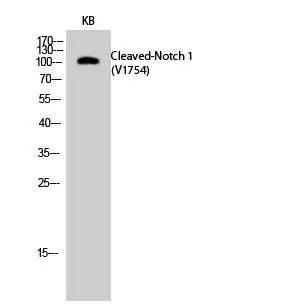
WB analysis of KB cell lysates using GTX86924 NOTCH1 (cleaved Val1754) antibody. Dilution : 1:500
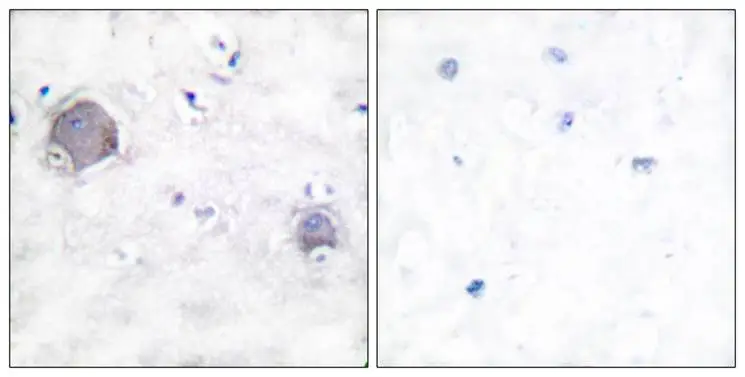
WB analysis of KB cell lysates using GTX86924 NOTCH1 (cleaved Val1754) antibody. Dilution : 1:500
NOTCH1 (cleaved Val1754) antibody
GTX86924

ApplicationsWestern Blot, ImmunoHistoChemistry, ImmunoHistoChemistry Paraffin
Product group Antibodies
ReactivityHuman
TargetNOTCH1
Overview
- SupplierGeneTex
- Product NameNOTCH1 (cleaved Val1754) antibody
- Delivery Days Customer9
- Application Supplier NoteWB: 1:500~1:1000. IHC-P: 1:50~1:100. *Optimal dilutions/concentrations should be determined by the researcher.Not tested in other applications.
- ApplicationsWestern Blot, ImmunoHistoChemistry, ImmunoHistoChemistry Paraffin
- CertificationResearch Use Only
- ClonalityPolyclonal
- ConjugateUnconjugated
- Gene ID4851
- Target nameNOTCH1
- Target descriptionnotch receptor 1
- Target synonymsAOS5, AOVD1, TAN1, hN1, neurogenic locus notch homolog protein 1, Notch homolog 1, translocation-associated, notch 1, translocation-associated notch protein TAN-1
- HostRabbit
- IsotypeIgG
- Protein IDP46531
- Protein NameNeurogenic locus notch homolog protein 1
- Scientific DescriptionThis gene encodes a member of the Notch family. Members of this Type 1 transmembrane protein family share structural characteristics including an extracellular domain consisting of multiple epidermal growth factor-like (EGF) repeats, and an intracellular domain consisting of multiple, different domain types. Notch family members play a role in a variety of developmental processes by controlling cell fate decisions. The Notch signaling network is an evolutionarily conserved intercellular signaling pathway which regulates interactions between physically adjacent cells. In Drosophilia, notch interaction with its cell-bound ligands (delta, serrate) establishes an intercellular signaling pathway that plays a key role in development. Homologues of the notch-ligands have also been identified in human, but precise interactions between these ligands and the human notch homologues remain to be determined. This protein is cleaved in the trans-Golgi network, and presented on the cell surface as a heterodimer. This protein functions as a receptor for membrane bound ligands, and may play multiple roles during development. [provided by RefSeq, Jul 2008]
- ReactivityHuman
- Storage Instruction-20°C or -80°C,2°C to 8°C
- UNSPSC12352203
Datasheet
Related products
Product group Antibodies

Anti-NOTCH1 Antibody144-07636
ApplicationsImmunoFluorescence, Western Blot, ImmunoHistoChemistry
ReactivityHuman, Mouse, Rat
TargetNOTCH1
- SizePrice
Product group Antibodies

Anti-Notch 1 [E6]Ab00175-23.0
ApplicationsELISA, ImmunoHistoChemistry
ReactivityHuman, Mouse
TargetNOTCH1
- SizePrice

Product group Antibodies

Anti-Notch1 Antibody Picoband(r)A00033-2-CARRIER-FREE
ApplicationsWestern Blot
ReactivityHuman, Mouse
TargetNOTCH1
- SizePrice
![IP analysis of 293T whole cell lysate using GTX02821 NOTCH1 antibody [GT1224]. Total extract : 200μg IP antibody amount : 3μg Dilution : 1:1000](https://www.genetex.com/upload/website/prouct_img/normal/GTX02821/CutImage_A19090_IP_01_(1071532)_w_23053122_112.webp)
Product group Antibodies
NOTCH1 antibody [GT1224]GTX02821
ApplicationsImmunoPrecipitation, Western Blot
ReactivityHuman, Mouse
TargetNOTCH1
- SizePrice
![Various whole cell extracts (30 μg) were separated by 5% SDS-PAGE, and the membrane was blotted with NOTCH1 antibody [HL1281] (GTX636683) diluted at 1:1000. The HRP-conjugated anti-rabbit IgG antibody (GTX213110-01) was used to detect the primary antibody.](https://www.genetex.com/upload/website/prouct_img/normal/GTX636683/GTX636683_44606_20220304_WB_w_23061202_766.webp)
Product group Antibodies
NOTCH1 antibody [HL1281]GTX636683
ApplicationsWestern Blot
ReactivityHuman
TargetNOTCH1
- SizePrice
![IHC-P analysis of breast tissue using GTX84019 NOTCH1 antibody [3E12]. Antigen retrieval : Heat-induced epitope retrieval by 10mM citrate buffer, pH6.0, 100oC for 10min.](https://www.genetex.com/upload/website/prouct_img/normal/GTX84019/GTX84019_2167_IHC-P_w_23061420_209.webp)
Product group Antibodies
NOTCH1 antibody [3E12]GTX84019
ApplicationsImmunoFluorescence, Western Blot, ImmunoCytoChemistry, ImmunoHistoChemistry, ImmunoHistoChemistry Paraffin
ReactivityHuman
TargetNOTCH1
- SizePrice
![IHC-P analysis of human tonsil tissue using GTX84020 NOTCH1 antibody [4C9].](https://www.genetex.com/upload/website/prouct_img/normal/GTX84020/GTX84020_2189_IHC-P_w_23061420_725.webp)
Product group Antibodies
NOTCH1 antibody [4C9]GTX84020
ApplicationsWestern Blot, ImmunoHistoChemistry, ImmunoHistoChemistry Paraffin
ReactivityHuman
TargetNOTCH1
- SizePrice
Product group Antibodies

ApplicationsImmunoPrecipitation, Western Blot, ImmunoCytoChemistry, ImmunoHistoChemistry
ReactivityPorcine
TargetNOTCH1
- SizePrice
Product group Antibodies
References

Notch1 Polyclonal AntibodyBS-1335R
ApplicationsFlow Cytometry, ImmunoFluorescence, Western Blot, ELISA, ImmunoCytoChemistry, ImmunoHistoChemistry, ImmunoHistoChemistry Frozen, ImmunoHistoChemistry Paraffin
ReactivityHuman, Mouse, Rat
TargetNOTCH1
- SizePrice