

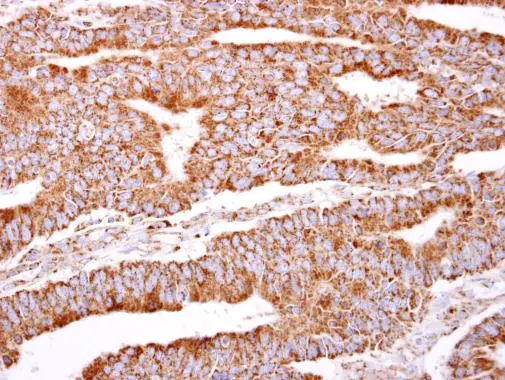
PACSIN2 antibody [N2C3] detects PACSIN2 protein at cytosol on human colon carcinoma by immunohistochemical analysis. Sample: Paraffin-embedded human colon carcinoma. PACSIN2 antibody [N2C3] (GTX104204) dilution: 1:500.
Antigen Retrieval: Trilogy? (EDTA based, pH 8.0) buffer, 15min
![Various whole cell extracts (30 μg) were separated by 10% SDS-PAGE, and the membrane was blotted with PACSIN2 antibody [N2C3] (GTX104204) diluted at 1:1000. The HRP-conjugated anti-rabbit IgG antibody (GTX213110-01) was used to detect the primary antibody.](https://www.genetex.com/upload/website/prouct_img/normal/GTX104204/GTX104204_39918_20170420_WB_w_23060120_336.webp "Various whole cell extracts (30 μg) were separated by 10% SDS-PAGE, and the membrane was blotted with PACSIN2 antibody [N2C3] (GTX104204) diluted at 1:1000. The HRP-conjugated anti-rabbit IgG antibody (GTX213110-01) was used to detect the primary antibody.")
PACSIN2 antibody [N2C3] detects PACSIN2 protein at cytosol on human colon carcinoma by immunohistochemical analysis. Sample: Paraffin-embedded human colon carcinoma. PACSIN2 antibody [N2C3] (GTX104204) dilution: 1:500.
Antigen Retrieval: Trilogy? (EDTA based, pH 8.0) buffer, 15min
PACSIN2 antibody [N2C3]
GTX104204

ApplicationsWestern Blot, ImmunoHistoChemistry, ImmunoHistoChemistry Paraffin
Product group Antibodies
ReactivityHuman
TargetPACSIN2
Overview
- SupplierGeneTex
- Product NamePACSIN2 antibody [N2C3]
- Delivery Days Customer9
- Application Supplier NoteWB: 1:500-1:3000. IHC-P: 1:100-1:1000. *Optimal dilutions/concentrations should be determined by the researcher.Not tested in other applications.
- ApplicationsWestern Blot, ImmunoHistoChemistry, ImmunoHistoChemistry Paraffin
- CertificationResearch Use Only
- ClonalityPolyclonal
- Concentration1 mg/ml
- ConjugateUnconjugated
- Gene ID11252
- Target namePACSIN2
- Target descriptionprotein kinase C and casein kinase substrate in neurons 2
- Target synonymsSDPII, protein kinase C and casein kinase substrate in neurons protein 2, cytoplasmic phosphoprotein PACSIN2, syndapin-2, syndapin-II, syndapin2
- HostRabbit
- IsotypeIgG
- Protein IDQ9UNF0
- Protein NameProtein kinase C and casein kinase substrate in neurons protein 2
- Scientific DescriptionThis gene is a member of the protein kinase C and casein kinase substrate in neurons family. The encoded protein is involved in linking the actin cytoskeleton with vesicle formation by regulating tubulin polymerization. Alternative splicing results in multiple transcript variants. [provided by RefSeq]
- ReactivityHuman
- Storage Instruction-20°C or -80°C,2°C to 8°C
- UNSPSC12352203
References
- Popov S, Popova E, Inoue M, et al. HIV-1 gag recruits PACSIN2 to promote virus spreading. Proc Natl Acad Sci U S A. 2018,115(27):7093-7098. doi: 10.1073/pnas.1801849115Read this paper
- Karbalaei MS, Rippe C, Albinsson S, et al. Impaired contractility and detrusor hypertrophy in cavin-1-deficient mice. Eur J Pharmacol. 2012,689(1-3):179-85. doi: 10.1016/j.ejphar.2012.05.023Read this paper
Datasheet
Related products
Product group Antibodies

Anti-PACSIN2 Antibody102-20258
ApplicationsWestern Blot
TargetPACSIN2
- SizePrice
Product group Antibodies

PACSIN2 Polyclonal AntibodyCAC15670
ApplicationsImmunoFluorescence, ImmunoPrecipitation, Western Blot, ELISA, ImmunoHistoChemistry
TargetPACSIN2
- SizePrice
Product group Antibodies

PACSIN2 Monoclonal AntibodyBSM-51639M
ApplicationsWestern Blot
ReactivityHuman, Mouse
TargetPACSIN2
- SizePrice
Product group Antibodies

[KO Validated] PACSIN2 AntibodyCAB19941
ReactivityHuman
TargetPACSIN2
- SizePrice

Product group Antibodies

Anti-PACSIN2 AntibodyHPA049854
ApplicationsImmunoCytoChemistry, ImmunoHistoChemistry
ReactivityHuman
TargetPACSIN2
- SizePrice
Product group Antibodies

PACSIN2 AntibodyCSB-PA793216
ApplicationsELISA, ImmunoHistoChemistry
ReactivityHuman, Mouse, Rat
TargetPACSIN2
- SizePrice
Product group Antibodies

PACSIN2 AntibodyLS-C409330
ApplicationsWestern Blot, ImmunoHistoChemistry
ReactivityHuman, Mouse
TargetPACSIN2
- SizePrice
Product group Antibodies

Anti-PACSIN2 AntibodyA308485
ApplicationsWestern Blot
ReactivityHuman
- SizePrice

Product group Antibodies

Anti-PACSIN2 Antibody Picoband(r)A04211-2-CARRIER-FREE
ApplicationsFlow Cytometry, ImmunoFluorescence, Western Blot, ELISA, ImmunoCytoChemistry, ImmunoHistoChemistry
ReactivityHuman, Monkey, Mouse, Rat
TargetPACSIN2
- SizePrice