

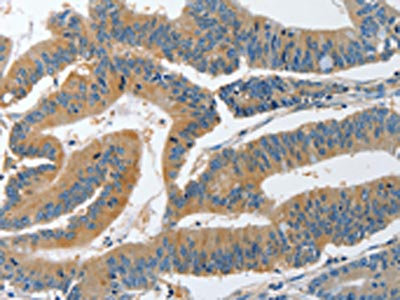
The image on the left is immunohistochemistry of paraffin-embedded Human colon cancer tissue using CSB-PA158009(PIK3R4 Antibody) at dilution 1/25, on the right is treated with synthetic peptide. (Original magnification: x200)
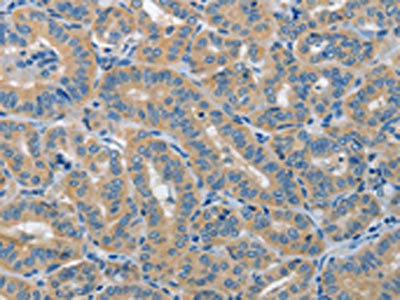
The image on the left is immunohistochemistry of paraffin-embedded Human colon cancer tissue using CSB-PA158009(PIK3R4 Antibody) at dilution 1/25, on the right is treated with synthetic peptide. (Original magnification: x200)
PIK3R4 Antibody
CSB-PA158009

ApplicationsELISA, ImmunoHistoChemistry
Product group Antibodies
ReactivityHuman, Mouse, Rat
TargetPIK3R4
Overview
- SupplierCusabio
- Product NamePIK3R4 Antibody
- Delivery Days Customer20
- ApplicationsELISA, ImmunoHistoChemistry
- CertificationResearch Use Only
- ClonalityPolyclonal
- ConjugateUnconjugated
- Gene ID30849
- Target namePIK3R4
- Target descriptionphosphoinositide-3-kinase regulatory subunit 4
- Target synonymsVPS15, p150, phosphoinositide 3-kinase regulatory subunit 4, PI3-kinase p150 subunit, PI3-kinase regulatory subunit 4, phosphatidylinositol 3-kinase-associated p150, phosphoinositide 3-kinase adaptor protein, phosphoinositide-3-kinase, regulatory subunit 4, p150
- HostRabbit
- IsotypeIgG
- Protein IDQ99570
- Protein NamePhosphoinositide 3-kinase regulatory subunit 4
- Scientific DescriptionPhosphoinositide 3-kinase regulatory subunit 4, also known as PI3-kinase regulatory subunit 4 or PI3-kinase p150 subunit or phosphoinositide 3-kinase adaptor protein, or VPS15 is an enzyme that in humans is encoded by the PIK3R4 gene. The PI3-kinases regulate cellular signaling networks that are involved in processes linked to the survival, growth, proliferation, metabolism and specialized differentiated functions of cells. The subversion of this network is common in cancer and has also been linked to disorders of inflammation.
- ReactivityHuman, Mouse, Rat
- Storage Instruction-20°C or -80°C
- UNSPSC41116161
Related products
Product group Antibodies

Anti-PIK3R4 AntibodyA45541
ApplicationsImmunoHistoChemistry
ReactivityHuman, Mouse, Rat
- SizePrice

Product group Antibodies

Anti-PIK3R4 Antibody Picoband(r)A06618-1-CARRIER-FREE
ApplicationsFlow Cytometry, Western Blot, ELISA
ReactivityHuman
TargetPIK3R4
- SizePrice
Product group Antibodies

Anti-PIK3R4 Antibody144-61228
ApplicationsWestern Blot
ReactivityHuman, Mouse
TargetPIK3R4
- SizePrice

Product group Antibodies

PI3 kinase p150 Monoclonal AntibodyBSM-63077R
ApplicationsFlow Cytometry, ImmunoFluorescence, Western Blot, ImmunoCytoChemistry, ImmunoHistoChemistry, ImmunoHistoChemistry Frozen, ImmunoHistoChemistry Paraffin
ReactivityHuman, Mouse, Rat
TargetPIK3R4
- SizePrice
Product group Antibodies

PIK3R4 AntibodyLS-C406168
ApplicationsELISA, ImmunoHistoChemistry
ReactivityHuman, Mouse, Rat
TargetPIK3R4
- SizePrice
![Immunoprecipitation of PI3-Kinase p150 protein from HeLa whole cell extracts using 5 μg of PI3-Kinase p150 antibody [C1C3] (GTX108953). Western blot analysis was performed using PI3-Kinase p150 antibody [C1C3] (GTX108953). EasyBlot anti-Rabbit IgG (GTX221666-01) was used as a secondary reagent.](https://www.genetex.com/upload/website/prouct_img/normal/GTX108953/GTX108953_40016_20150209_IP_w_23060120_821.webp)
Product group Antibodies

PI3 kinase p150 antibody [C1C3]GTX108953
ApplicationsImmunoPrecipitation, Western Blot
ReactivityHuman, Mouse
TargetPIK3R4
- SizePrice


Product group Antibodies

Anti-PIK3R4 AntibodyHPA036032
ApplicationsWestern Blot, ImmunoHistoChemistry
ReactivityHuman
TargetPIK3R4
- SizePrice
Product group Antibodies

ApplicationsImmunoFluorescence, Western Blot, ELISA, ImmunoCytoChemistry
ReactivityHuman
TargetPIK3R4
- SizePrice