

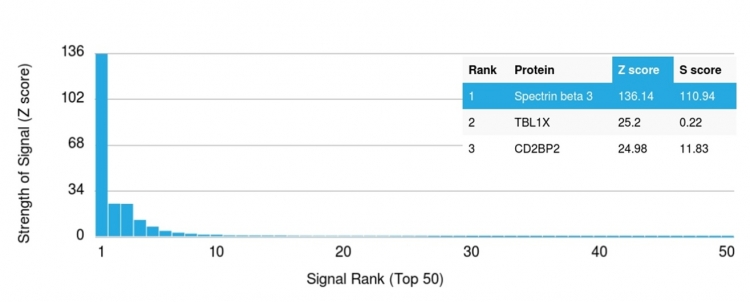
Analysis of Protein Array containing more than 19,000 full-length human proteins using Spectrin beta III Mouse Monoclonal Antibody (SPTBN2/1582). Z- and S- Score: The Z-score represents the strength of a signal that a monoclonal antibody produces when binding to a particular protein on the HuProtTM array. Z-scores are described in units of standard deviations (SD’s) above the mean value of all signals generated on that array. If targets on HuProtTM are arranged in descending order of the Z-score, the S-score is the difference (also in units of SD’s) between the Z-score. S-score therefore represents the relative target specificity of a Monoclonal Antibody to its intended target. A Monoclonal Antibody is considered to specific to its intended target if the Monoclonal Antibody has an S-score of at least 2.5. For example, if a Monoclonal Antibody binds to protein X with a Z-score of 43 and to protein Y with a Z-score of 14, then the S-score for the binding of that Monoclonal Antibody to protein X is equal to 29.
![IHC-P analysis of human pancreas tissue using GTX35089 SPTBN2 antibody [SPTBN2/1582].](https://www.genetex.com/upload/website/prouct_img/normal/GTX35089/GTX35089_20200115_IHC-P_896_w_23060801_994.webp "IHC-P analysis of human pancreas tissue using GTX35089 SPTBN2 antibody [SPTBN2/1582].")
![WB analysis of HeLa and 293 cell lysates using GTX35089 SPTBN2 antibody [SPTBN2/1582].](https://www.genetex.com/upload/website/prouct_img/normal/GTX35089/GTX35089_20200115_WB_105_w_23060801_259.webp "WB analysis of HeLa and 293 cell lysates using GTX35089 SPTBN2 antibody [SPTBN2/1582].")
![FACS analysis of HeLa cells using GTX35089 SPTBN2 antibody [SPTBN2/1582]. Blue : Primary antibody Red : Isotype control](https://www.genetex.com/upload/website/prouct_img/normal/GTX35089/GTX35089_20200115_FACS_188_w_23060801_152.webp "FACS analysis of HeLa cells using GTX35089 SPTBN2 antibody [SPTBN2/1582]. Blue : Primary antibody Red : Isotype control")
![IHC-P analysis of human histiocytoma tissue using GTX35089 Factor XIIIa antibody [F13A1/1448].](https://www.genetex.com/upload/website/prouct_img/normal/GTX35089/GTX35089_20200115_IHC-P_621_w_23060801_390.webp "IHC-P analysis of human histiocytoma tissue using GTX35089 Factor XIIIa antibody [F13A1/1448].")
![WB analysis of HeLa cell lysate using GTX35089 SPTBN2 antibody [SPTBN2/1582].](https://www.genetex.com/upload/website/prouct_img/normal/GTX35089/GTX35089_20200115_WB_162_w_23060801_185.webp "WB analysis of HeLa cell lysate using GTX35089 SPTBN2 antibody [SPTBN2/1582].")
Analysis of Protein Array containing more than 19,000 full-length human proteins using Spectrin beta III Mouse Monoclonal Antibody (SPTBN2/1582). Z- and S- Score: The Z-score represents the strength of a signal that a monoclonal antibody produces when binding to a particular protein on the HuProtTM array. Z-scores are described in units of standard deviations (SD’s) above the mean value of all signals generated on that array. If targets on HuProtTM are arranged in descending order of the Z-score, the S-score is the difference (also in units of SD’s) between the Z-score. S-score therefore represents the relative target specificity of a Monoclonal Antibody to its intended target. A Monoclonal Antibody is considered to specific to its intended target if the Monoclonal Antibody has an S-score of at least 2.5. For example, if a Monoclonal Antibody binds to protein X with a Z-score of 43 and to protein Y with a Z-score of 14, then the S-score for the binding of that Monoclonal Antibody to protein X is equal to 29.
SPTBN2 antibody [SPTBN2/1582]
GTX35089

ApplicationsFlow Cytometry, Western Blot, ELISA, ImmunoHistoChemistry, ImmunoHistoChemistry Paraffin, Other Application
Product group Antibodies
ReactivityHuman
TargetSPTBN2
Overview
- SupplierGeneTex
- Product NameSPTBN2 antibody [SPTBN2/1582]
- Delivery Days Customer9
- Application Supplier NoteWB: 1-2microg/ml. IHC-P: 1-2microg/ml for 30 minutes at RT. FCM: 1-2microg/106 cells. ELISA: 2-4microg/ml (for coating). *Optimal dilutions/concentrations should be determined by the researcher.Not tested in other applications.
- ApplicationsFlow Cytometry, Western Blot, ELISA, ImmunoHistoChemistry, ImmunoHistoChemistry Paraffin, Other Application
- CertificationResearch Use Only
- ClonalityMonoclonal
- Clone IDSPTBN2/1582
- Concentration0.2 mg/ml
- ConjugateUnconjugated
- Gene ID6712
- Target nameSPTBN2
- Target descriptionspectrin beta, non-erythrocytic 2
- Target synonymsGTRAP41, SCA5, SCAR14, spectrin beta chain, non-erythrocytic 2, beta-III spectrin, glutamate transporter EAAT4-associated protein 41, spectrin beta III sigma 2, spectrin beta chain, brain 2, spectrin, non-erythroid beta chain 2, spinocerebellar ataxia 5 protein
- HostMouse
- IsotypeIgG2a
- Protein IDO15020
- Protein NameSpectrin beta chain, non-erythrocytic 2
- Scientific DescriptionSpectrins are principle components of a cells membrane-cytoskeleton and are composed of two alpha and two beta spectrin subunits. The protein encoded by this gene (SPTBN2), is called spectrin beta non-erythrocytic 2 or beta-III spectrin. It is related to, but distinct from, the beta-II spectrin gene which is also known as spectrin beta non-erythrocytic 1 (SPTBN1). SPTBN2 regulates the glutamate signaling pathway by stabilizing the glutamate transporter EAAT4 at the surface of the plasma membrane. Mutations in this gene cause a form of spinocerebellar ataxia, SCA5, that is characterized by neurodegeneration, progressive locomotor incoordination, dysarthria, and uncoordinated eye movements. [provided by RefSeq, Dec 2009]
- ReactivityHuman
- Storage Instruction-20°C or -80°C,2°C to 8°C
- UNSPSC41116161
Datasheet
Related products

Product group Antibodies

Anti-SPTBN2 Antibody Picoband(r)A05492-CARRIER-FREE
ApplicationsFlow Cytometry, Western Blot, ELISA, ImmunoHistoChemistry
ReactivityHuman, Mouse, Rat
TargetSPTBN2
- SizePrice
Product group Antibodies

ReactivityHuman
TargetSPTBN2
- SizePrice
Product group Antibodies

SPTBN2 Polyclonal AntibodyBS-10784R
ApplicationsImmunoFluorescence, ImmunoCytoChemistry, ImmunoHistoChemistry, ImmunoHistoChemistry Frozen, ImmunoHistoChemistry Paraffin
TargetSPTBN2
- SizePrice
Product group Antibodies

SPTBN2 AntibodyCSB-PA022636GA01HU
ApplicationsWestern Blot, ELISA
ReactivityHuman
TargetSPTBN2
- SizePrice
![WB analysis of PANC-1 cell lysate using GTX17813 SPTBN2 antibody [SPTBN2/1778].](https://www.genetex.com/upload/website/prouct_img/normal/GTX17813/GTX17813_20200115_WB_1649_w_23060620_172.webp)
Product group Antibodies
SPTBN2 antibody [SPTBN2/1778]GTX17813
ApplicationsImmunoFluorescence, Western Blot, ELISA, ImmunoCytoChemistry, ImmunoHistoChemistry, ImmunoHistoChemistry Paraffin, Other Application
ReactivityHuman
TargetSPTBN2
- SizePrice
![WB analysis of PANC-1 whole cell lysate using GTX02716 SPTBN2 antibody [SPTBN2/2894R].](https://www.genetex.com/upload/website/prouct_img/normal/GTX02716/GTX02716_20210319_WB_1_w_23053122_554.webp)
Product group Antibodies
SPTBN2 antibody [SPTBN2/2894R]GTX02716
ApplicationsFlow Cytometry, Western Blot, ELISA, ImmunoHistoChemistry, ImmunoHistoChemistry Paraffin
ReactivityHuman
TargetSPTBN2
- SizePrice
![ICC/IF analysis of HeLa cells using GTX02717 SPTBN2 antibody [SPTBN2/2887R]. Green : Primary antibody Red : nuclear counterstain](https://www.genetex.com/upload/website/prouct_img/normal/GTX02717/GTX02717_20210319_ICCIF_w_23053122_473.webp)
Product group Antibodies
SPTBN2 antibody [SPTBN2/2887R]GTX02717
ApplicationsFlow Cytometry, ImmunoFluorescence, Western Blot, ImmunoCytoChemistry, ImmunoHistoChemistry, ImmunoHistoChemistry Paraffin
ReactivityHuman
TargetSPTBN2
- SizePrice
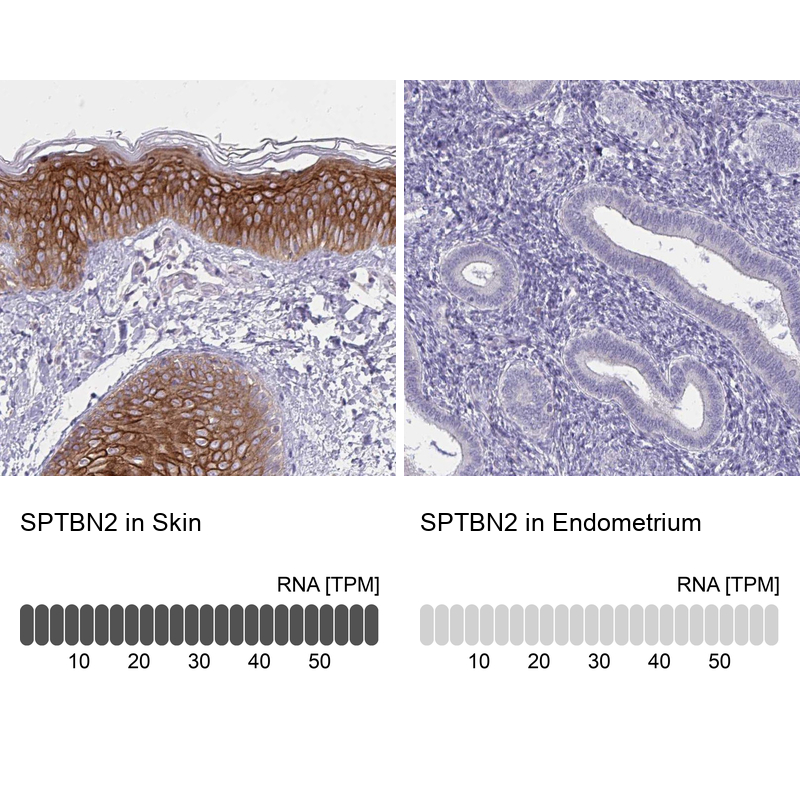
Product group Antibodies

Anti-SPTBN2 AntibodyHPA039293
ApplicationsImmunoCytoChemistry, ImmunoHistoChemistry
ReactivityHuman
TargetSPTBN2
- SizePrice
![ICC/IF analysis of HeLa cells using GTX35090 SPTBN2 antibody [SPTBN2/1583]. Green : Primary antibody Red : nucleus](https://www.genetex.com/upload/website/prouct_img/normal/GTX35090/GTX35090_20200115_ICC-IF_199_w_23060801_145.webp)
Product group Antibodies
SPTBN2 antibody [SPTBN2/1583]GTX35090
ApplicationsFlow Cytometry, ImmunoFluorescence, Western Blot, ImmunoCytoChemistry, ImmunoHistoChemistry, ImmunoHistoChemistry Paraffin, Other Application
ReactivityHuman
TargetSPTBN2
- SizePrice
![FACS analysis of HeLa cells using GTX35091 SPTBN2 antibody [SPTBN2/1584]. Blue : Primary antibody Red : Isotype control](https://www.genetex.com/upload/website/prouct_img/normal/GTX35091/GTX35091_20200115_FACS_187_w_23060801_214.webp)
Product group Antibodies
SPTBN2 antibody [SPTBN2/1584]GTX35091
ApplicationsFlow Cytometry, ImmunoFluorescence, Western Blot, ImmunoCytoChemistry, ImmunoHistoChemistry, ImmunoHistoChemistry Paraffin, Other Application
ReactivityHuman, Mouse, Rat
TargetSPTBN2
- SizePrice