

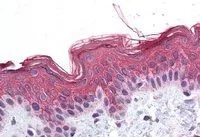
IHC-P analysis of human skin using GTX13535 ADAM17 antibody. Antigen retrieval : citrate buffer pH 6 Dilution : 3.75μg/ml
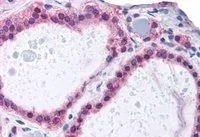
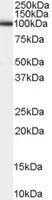
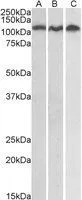
IHC-P analysis of human skin using GTX13535 ADAM17 antibody. Antigen retrieval : citrate buffer pH 6 Dilution : 3.75μg/ml
ADAM17 antibody
GTX13535

ApplicationsWestern Blot, ImmunoHistoChemistry, ImmunoHistoChemistry Paraffin
Product group Antibodies
ReactivityHuman
TargetADAM17
Overview
- SupplierGeneTex
- Product NameADAM17 antibody
- Delivery Days Customer9
- Application Supplier NoteWB: 0.1-0.3microg/ml. IHC-P: 3.75microg/ml. *Optimal dilutions/concentrations should be determined by the researcher.Not tested in other applications.
- ApplicationsWestern Blot, ImmunoHistoChemistry, ImmunoHistoChemistry Paraffin
- CertificationResearch Use Only
- ClonalityPolyclonal
- Concentration0.50 mg/ml
- ConjugateUnconjugated
- Gene ID6868
- Target nameADAM17
- Target descriptionADAM metallopeptidase domain 17
- Target synonymsADAM18, CD156B, CSVP, NISBD, NISBD1, TACE, disintegrin and metalloproteinase domain-containing protein 17, ADAM metallopeptidase domain 18, TNF-alpha convertase, TNF-alpha convertase enzyme, TNF-alpha converting enzyme, a disintegrin and metalloproteinase 17, cartilage snake venom-like protease, snake venom-like protease, tumor necrosis factor, alpha, converting enzyme
- HostGoat
- IsotypeIgG
- Protein IDP78536
- Protein NameDisintegrin and metalloproteinase domain-containing protein 17
- Scientific DescriptionThis gene encodes a member of the ADAM (a disintegrin and metalloprotease domain) family. Members of this family are membrane-anchored proteins structurally related to snake venom disintegrins, and have been implicated in a variety of biologic processes involving cell-cell and cell-matrix interactions, including fertilization, muscle development, and neurogenesis. The encoded preproprotein is proteolytically processed to generate the mature protease. The encoded protease functions in the ectodomain shedding of tumor necrosis factor-alpha, in which soluble tumor necrosis factor-alpha is released from the membrane-bound precursor. This protease also functions in the processing of numerous other substrates, including cell adhesion proteins, cytokine and growth factor receptors and epidermal growth factor (EGF) receptor ligands. The encoded protein also plays a prominent role in the activation of the Notch signaling pathway. Elevated expression of this gene has been observed in specific cell types derived from psoriasis, rheumatoid arthritis, multiple sclerosis and Crohns disease patients, suggesting that the encoded protein may play a role in autoimmune disease. [provided by RefSeq, Feb 2016]
- ReactivityHuman
- Storage Instruction-20°C or -80°C,2°C to 8°C
- UNSPSC41116161
Datasheet
Related products
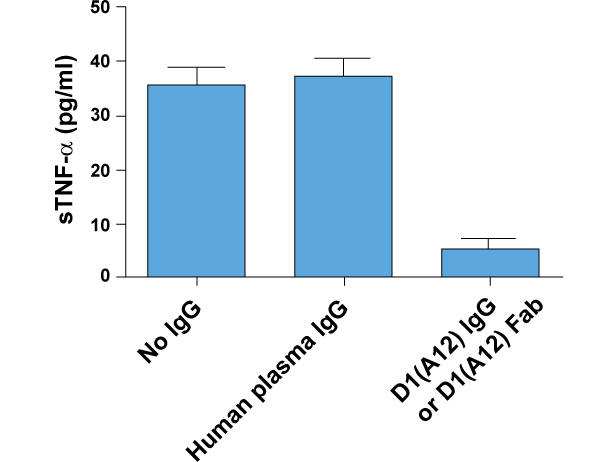
Product group Antibodies

ApplicationsFunctional Assay, Neutralisation/Blocking
ReactivityHuman
TargetADAM17
- SizePrice
Product group Antibodies

Anti-CD156b [hz1022C3], Human IgG1, kappaAB04681-10.0
ApplicationsFlow Cytometry, ELISA, Other Application
ReactivityHuman
TargetADAM17
- SizePrice
Product group Antibodies

Anti-ADAM17 (M) (322-340) Antibody130-10579
ApplicationsELISA
ReactivityHuman
TargetADAM17
- SizePrice

Product group Antibodies

Anti-ADAM17 Antibody Picoband(r)A00604-CARRIER-FREE
ApplicationsWestern Blot, ELISA
ReactivityHuman, Mouse, Rat
TargetADAM17
- SizePrice
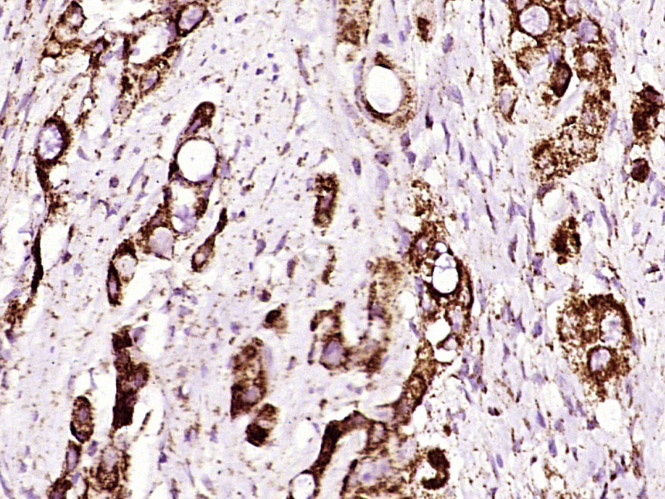
Product group Antibodies

ApplicationsImmunoFluorescence, Western Blot, ELISA, ImmunoCytoChemistry, ImmunoHistoChemistry, ImmunoHistoChemistry Frozen, ImmunoHistoChemistry Paraffin
ReactivityBovine, Human, Mouse, Porcine, Rat, Sheep
TargetADAM17
- SizePrice
Product group Antibodies

Goat anti-ADAM17 / TACEEB05382
ApplicationsWestern Blot, ELISA
ReactivityHuman, Mouse, Rat
TargetADAM17
- SizePrice
Product group Antibodies

ApplicationsImmunoPrecipitation, Western Blot, ImmunoCytoChemistry, ImmunoHistoChemistry
ReactivityMouse, Rat
TargetADAM17
- SizePrice
Product group Antibodies

Cleaved-ADAM17 (R215) AntibodyCSB-PA050198
ApplicationsWestern Blot, ELISA
ReactivityHuman
TargetADAM17
- SizePrice
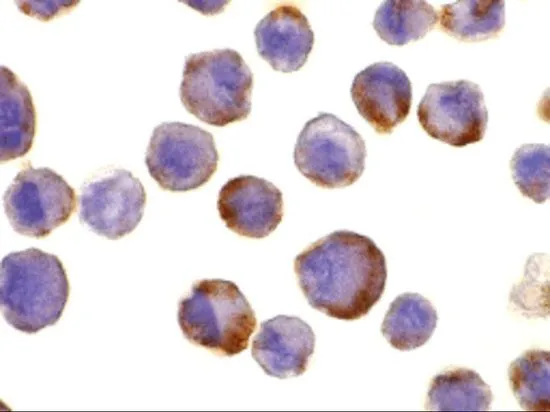
Product group Antibodies
ADAM17 antibodyGTX31632
ApplicationsImmunoFluorescence, Western Blot, ELISA, ImmunoCytoChemistry
ReactivityHuman, Rat
TargetADAM17
- SizePrice
![Wild-type (WT) and ADAM17 knockout (KO) HeLa (30 μg) were separated by 7.5% SDS-PAGE, and the membrane was blotted with ADAM17 antibody [C2C3], C-term (GTX101358) diluted at 1:500. The HRP-conjugated anti-rabbit IgG antibody (GTX213110-01) was used to detect the primary antibody.](https://www.genetex.com/upload/website/prouct_img/normal/GTX101358/GTX101358_44657_20220506_WB_KO_watermark_23010922_404.webp)
Product group Antibodies
ADAM17 antibody [C2C3], C-termGTX101358
ApplicationsWestern Blot, ImmunoHistoChemistry, ImmunoHistoChemistry Paraffin
ReactivityHuman, Mouse, Rat
TargetADAM17
- SizePrice