


Alpha Actinin 4 / ACTN4(93), Biotin conjugate, 0.1mg/mL [26628-22-8]
BNCB3450

ReactivityHuman
Product group Antibodies
TargetACTN4
Overview
- SupplierBiotium
- Product NameAlpha Actinin 4 / ACTN4(93), Biotin conjugate, 0.1mg/mL [26628-22-8]
- Delivery Days Customer9
- CAS Number26628-22-8
- CertificationResearch Use Only
- ClonalityMonoclonal
- Clone ID93
- Concentration0.1 mg/ml
- ConjugateBiotin
- Gene ID81
- Target nameACTN4
- Target descriptionactinin alpha 4
- Target synonymsACTININ-4, FSGS, FSGS1, alpha-actinin-4, focal segmental glomerulosclerosis 1, non-muscle alpha-actinin 4
- HostMouse
- IsotypeIgG
- Protein IDO43707
- Protein NameAlpha-actinin-4
- Scientific DescriptionAlpha actinins belong to the spectrin gene superfamily which represents a diverse group of cytoskeletal proteins, including the alpha and beta spectrins and dystrophins. There are four tissue-specific -actinins, namely -actinin-1, -actinin-2, -actinin-3 and -actinin-4, which are localized to muscle and non-muscle cells, including skeletal, cardiac and smooth muscle cells, as well as within the cytoskeleton. Alpha actinin is an actin-binding protein with multiple roles in different cell types. In nonmuscle cells, the cytoskeletal isoform is found along microfilament bundles and adherens-type junctions, where it is involved in binding actin to the membrane. In contrast, skeletal, cardiac, and smooth muscle isoforms are localized to the Z-disc and analogous dense bodies, where they help anchor the myofibrillar actin filaments. This gene encodes a nonmuscle, alpha actinin isoform which is concentrated in the cytoplasm, and thought to be involved in metastatic processes. Each -actinin protein contains one Actin-binding domain, two calponin-homology domains, two EF-hand domains and four spectrin repeats, through which they function as bundling proteins that can cross-link F-Actin, thus anchoring Actin to a variety of intracellular structures. Defects in the gene encoding -actinin-4 are the cause of focal segmental glomerulosclerosis 1 (FSGS1), a common renal lesion characterized by decreasing kidney function and, ultimately, renal failure. Primary antibodies are available purified, or with a selection of fluorescent CF® Dyes and other labels. CF® Dyes offer exceptional brightness and photostability. Note: Conjugates of blue fluorescent dyes like CF®405S and CF®405M are not recommended for detecting low abundance targets, because blue dyes have lower fluorescence and can give higher non-specific background than other dye colors.
- SourceAnimal
- ReactivityHuman
- Storage Instruction2°C to 8°C,RT
- UNSPSC41116161
MSDS
Related products
Product group Antibodies

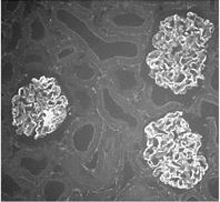
anti-alpha-Actinin-4, pAb (IG-701)AG-25T-0107
ApplicationsImmunoPrecipitation, Western Blot, ImmunoHistoChemistry
ReactivityHamster, Human, Mouse, Porcine, Rat
TargetACTN4
- SizePrice
Product group Antibodies

Anti-Alpha Actinin 4 [Ab01AA4]Ab02447-10.0
ApplicationsImmunoPrecipitation, ELISA, ImmunoHistoChemistry
ReactivityHuman
TargetACTN4
- SizePrice

Product group Antibodies

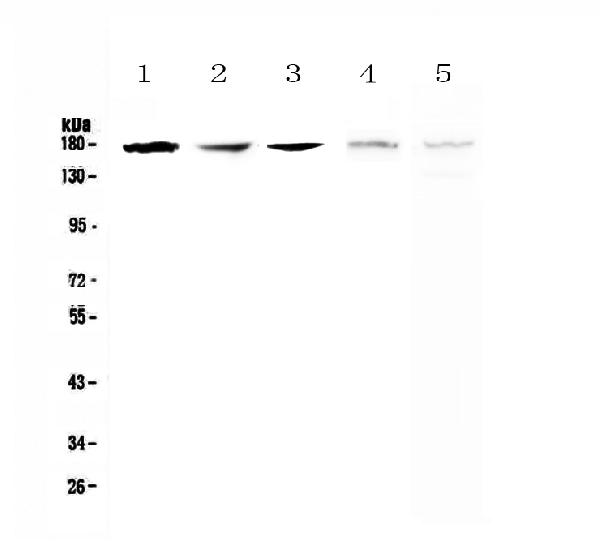
Anti-IRE1/ERN1 Antibody Picoband(r)A00683-1-CARRIER-FREE
ApplicationsFlow Cytometry, ImmunoFluorescence, Western Blot, ELISA, ImmunoCytoChemistry
ReactivityHuman, Mouse, Rat
TargetACTN4
- SizePrice
Product group Antibodies

Anti-ACTN4 Antibody144-64273
ApplicationsImmunoFluorescence, Western Blot
ReactivityHuman, Mouse, Rat
TargetACTN4
- SizePrice
Product group Antibodies

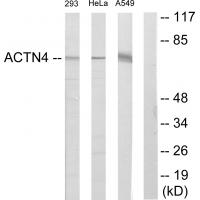
Anti-ACTN4 AntibodyA42831
ApplicationsWestern Blot
ReactivityHuman, Mouse, Rat
- SizePrice
Product group Antibodies

alpha Actinin 4 Recombinant AntibodyBSM-60423R
ApplicationsImmunoFluorescence, Western Blot, ImmunoCytoChemistry, ImmunoHistoChemistry, ImmunoHistoChemistry Frozen, ImmunoHistoChemistry Paraffin
ReactivityHuman, Mouse
TargetACTN4
- SizePrice
Product group Antibodies

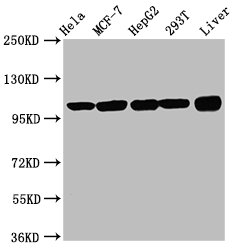
ACTN4 AntibodyCSB-PA00814A0RB
ApplicationsImmunoFluorescence, Western Blot, ELISA, ImmunoHistoChemistry
ReactivityHuman, Rat
TargetACTN4
- SizePrice
Product group Antibodies

Actn4 Polyclonal AntibodyCAC10364
ApplicationsImmunoFluorescence, Western Blot, ELISA, ImmunoHistoChemistry
ReactivityRat
TargetACTN4
- SizePrice
![alpha Actinin 4 antibody [C2C3], C-term detects ACTN4 protein by western blot analysis. A. 30 μg Neuro2A whole cell lysate/extract B. 30 μg GL261 whole cell lysate/extract C. 30 μg C8D30 whole cell lysate/extract D. 30 μg NIH-3T3 whole cell lysate/extract E. 30 μg BCL-1 whole cell lysate/extract F. 30 μg Raw264.7 whole cell lysate/extract G. 30 μg C2C12 whole cell lysate/extract 7.5% SDS-PAGE alpha Actinin 4 antibody [C2C3], C-term (GTX101669) dilution: 1:1000 The HRP-conjugated anti-rabbit IgG antibody (GTX213110-01) was used to detect the primary antibody.](https://www.genetex.com/upload/website/prouct_img/normal/GTX101669/GTX101669_40205_WB_M_w_23060100_117.webp)
Product group Antibodies

ApplicationsImmunoFluorescence, Western Blot, ImmunoCytoChemistry, ImmunoHistoChemistry, ImmunoHistoChemistry Paraffin
ReactivityHuman, Mouse, Rat
TargetACTN4
- SizePrice