

ATP5F1A Antibody, FITC conjugated
CSB-PA002344HC01HU

ReactivityHuman
Product group Antibodies
TargetATP5F1A
Overview
- SupplierCusabio
- Product NameATP5F1A Antibody, FITC conjugated
- Delivery Days Customer20
- CertificationResearch Use Only
- ClonalityPolyclonal
- ConjugateFITC
- Gene ID498
- Target nameATP5F1A
- Target descriptionATP synthase F1 subunit alpha
- Target synonymsATP5A, ATP5A1, ATP5AL2, ATPM, COXPD22, HEL-S-123m, MC5DN4, MC5DN4A, MC5DN4B, MOM2, OMR, ORM, hATP1, ATP synthase F(1) complex subunit alpha, mitochondrial, ATP synthase alpha chain, mitochondrial, ATP synthase, H+ transporting, mitochondrial F1 complex, alpha subunit 1, cardiac muscle, ATP sythase (F1-ATPase) alpha subunit, epididymis secretory sperm binding protein Li 123m, mitochondrial ATP synthetase, oligomycin-resistant
- HostRabbit
- IsotypeIgG
- Protein IDP25705
- Protein NameATP synthase F(1) complex subunit alpha, mitochondrial
- Scientific DescriptionMitochondrial membrane ATP synthase (F(1)F(0) ATP synthase or Complex V) produces ATP from ADP in the presence of a proton gradient across the membrane which is generated by electron transport complexes of the respiratory chain. F-type ATPases consist of two structural domains, F(1) - containing the extramembraneous catalytic core, and F(0) - containing the membrane proton channel, linked together by a central stalk and a peripheral stalk. During catalysis, ATP synthesis in the catalytic domain of F(1) is coupled via a rotary mechanism of the central stalk subunits to proton translocation. Subunits alpha and beta form the catalytic core in F(1). Rotation of the central stalk against the surrounding alpha(3)beta(3) subunits leads to hydrolysis of ATP in three separate catalytic sites on the beta subunits. Subunit alpha does not bear the catalytic high-affinity ATP-binding sites (By similarity).
- ReactivityHuman
- Storage Instruction-20°C or -80°C
- UNSPSC41116161
Related products
Product group Antibodies

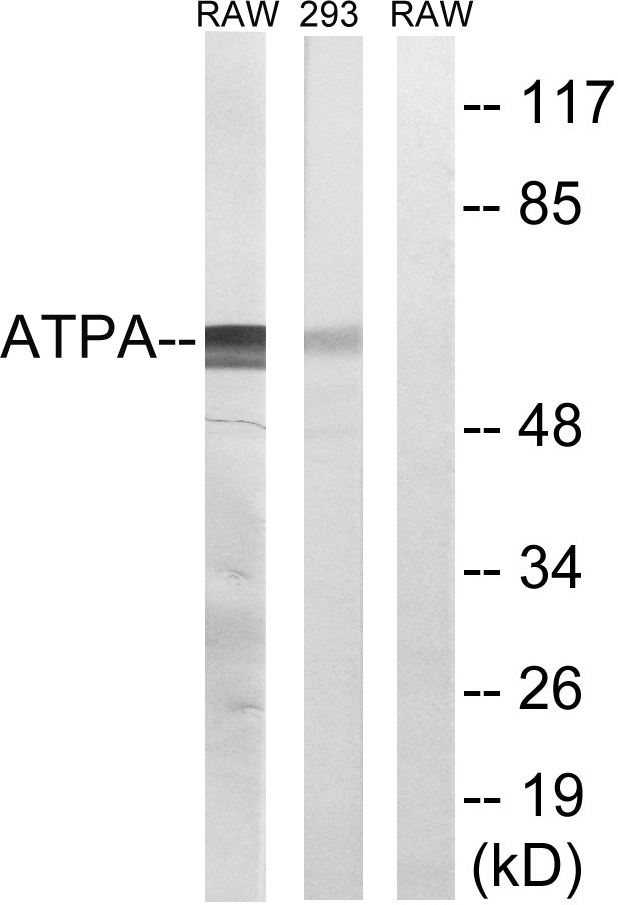
Anti-ATP5A1 AntibodyA96952
ApplicationsWestern Blot, ELISA
ReactivityHuman, Mouse, Rat
- SizePrice
Product group Antibodies

Anti-ATP5A1 Antibody144-05884
ApplicationsImmunoFluorescence, ImmunoPrecipitation, Western Blot, ImmunoHistoChemistry
ReactivityHuman, Mouse, Rat
TargetATP5F1A
- SizePrice

Product group Antibodies

Anti-ATP5F1A Antibody Picoband(r)A32267-2-CARRIER-FREE
ApplicationsFlow Cytometry, ImmunoFluorescence, Western Blot, ELISA, ImmunoCytoChemistry, ImmunoHistoChemistry
ReactivityHuman, Mouse, Rat
TargetATP5F1A
- SizePrice
Product group Antibodies

ATP5A Recombinant Antibody, Biotin ConjugatedBSM-61444R-BIOTIN
ApplicationsWestern Blot, ImmunoHistoChemistry, ImmunoHistoChemistry Frozen, ImmunoHistoChemistry Paraffin
ReactivityHuman, Mouse, Rat
TargetATP5F1A
- SizePrice
Product group Antibodies
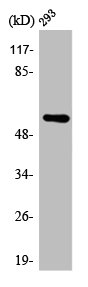
ATP5A1 AntibodyCSB-PA000951
ApplicationsWestern Blot, ELISA, ImmunoHistoChemistry
ReactivityHuman, Mouse, Rat
TargetATP5F1A
- SizePrice
Product group Antibodies
References

Goat anti-ATP5A1EB12389
ApplicationsWestern Blot, ELISA
ReactivityBovine, Canine, Human, Mouse, Porcine, Rat
TargetATP5F1A
- SizePrice
Product group Antibodies

Atp5F1A Polyclonal AntibodyCAC07482
ApplicationsWestern Blot, ELISA
TargetATP5F1A
- SizePrice
Product group Antibodies

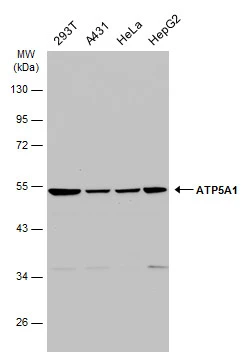
ATP5A1 antibody [C2C3], C-termGTX101741
ApplicationsImmunoFluorescence, Western Blot, ImmunoCytoChemistry, ImmunoHistoChemistry, ImmunoHistoChemistry Frozen, ImmunoHistoChemistry Paraffin
ReactivityHuman, Mouse, Rat
TargetATP5F1A
- SizePrice
Product group Antibodies

ApplicationsWestern Blot, ELISA
ReactivityHuman
TargetATP5F1A
- SizePrice

Product group Antibodies

Anti-ATP5A1 AntibodyHPA040622
ApplicationsWestern Blot, ImmunoHistoChemistry
ReactivityHuman
TargetATP5F1A
- SizePrice