

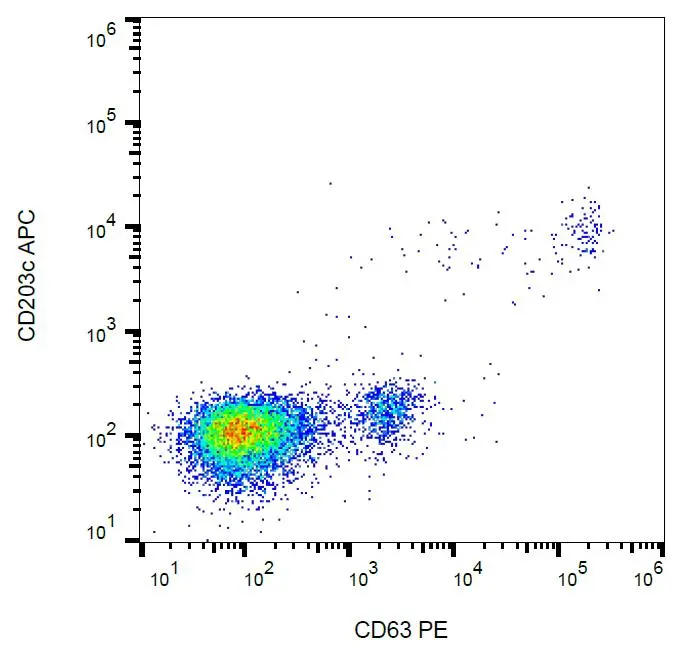
FACS analysis of IgE-activated peripheral blood using GTX18236 CD63 antibody [MEM-259] (PE).
FACS analysis of IgE-activated peripheral blood using GTX18236 CD63 antibody [MEM-259] (PE).
CD63 antibody [MEM-259] (PE)
GTX18236

ApplicationsFlow Cytometry
Product group Antibodies
ReactivityHuman
TargetCD63
Overview
- SupplierGeneTex
- Product NameCD63 antibody [MEM-259] (PE)
- Delivery Days Customer9
- Application Supplier NoteFACS: 20 microl reagent / 100 microl of whole blood or 106 cells in a suspension. *Optimal dilutions/concentrations should be determined by the researcher.Not tested in other applications.
- ApplicationsFlow Cytometry
- CertificationResearch Use Only
- ClonalityMonoclonal
- Clone IDMEM-259
- ConjugateRPE
- Gene ID967
- Target nameCD63
- Target descriptionCD63 molecule
- Target synonymsAD1, HOP-26, ME491, MLA1, OMA81H, Pltgp40, TSPAN30, CD63 antigen, AD1 antigen, CD63 antigen (melanoma 1 antigen), granulophysin, limp1, melanoma-associated antigen ME491, melanoma-associated antigen MLA1, ocular melanoma-associated antigen, tetraspanin-30, tspan-30
- HostMouse
- IsotypeIgG1
- Protein IDP08962
- Protein NameCD63 antigen
- Scientific DescriptionThe protein encoded by this gene is a member of the transmembrane 4 superfamily, also known as the tetraspanin family. Most of these members are cell-surface proteins that are characterized by the presence of four hydrophobic domains. The proteins mediate signal transduction events that play a role in the regulation of cell development, activation, growth and motility. The encoded protein is a cell surface glycoprotein that is known to complex with integrins. It may function as a blood platelet activation marker. Deficiency of this protein is associated with Hermansky-Pudlak syndrome. Also this gene has been associated with tumor progression. Alternative splicing results in multiple transcript variants encoding different protein isoforms. [provided by RefSeq, Apr 2012]
- ReactivityHuman
- Storage Instruction2°C to 8°C
- UNSPSC12352203
References
- Lanna A, Vaz B, D'Ambra C, et al. An intercellular transfer of telomeres rescues T cells from senescence and promotes long-term immunological memory. Nat Cell Biol. 2022,24(10):1461-1474. doi: 10.1038/s41556-022-00991-zRead this paper
- Zhang C, Chong X, Jiang F, et al. Plasma extracellular vesicle derived protein profile predicting and monitoring immunotherapeutic outcomes of gastric cancer. J Extracell Vesicles. 2022,11(4):e12209. doi: 10.1002/jev2.12209Read this paper
- Lenzini S, Debnath K, Joshi JC, et al. Cell-Matrix Interactions Regulate Functional Extracellular Vesicle Secretion from Mesenchymal Stromal Cells. ACS Nano. 2021,15(11):17439-17452. doi: 10.1021/acsnano.1c03231Read this paper
- Peng X, Li X, Yang S, et al. LINC00511 drives invasive behavior in hepatocellular carcinoma by regulating exosome secretion and invadopodia formation. J Exp Clin Cancer Res. 2021,40(1):183. doi: 10.1186/s13046-021-01990-yRead this paper
- Peng X, Yang L, Ma Y, et al. IKKβ activation promotes amphisome formation and extracellular vesicle secretion in tumor cells. Biochim Biophys Acta Mol Cell Res. 2021,1868(1):118857. doi: 10.1016/j.bbamcr.2020.118857Read this paper
- Yang L, Peng X, Li Y, et al. Long non-coding RNA HOTAIR promotes exosome secretion by regulating RAB35 and SNAP23 in hepatocellular carcinoma. Mol Cancer. 2019,18(1):78. doi: 10.1186/s12943-019-0990-6Read this paper
- Raulf N, Lucarelli P, Thavaraj S, et al. Annexin A1 regulates EGFR activity and alters EGFR-containing tumour-derived exosomes in head and neck cancers. Eur J Cancer. 2018,102:52-68. doi: 10.1016/j.ejca.2018.07.123Read this paper
- Jakhria T, Hellewell AL, Porter MY, et al. β2-microglobulin amyloid fibrils are nanoparticles that disrupt lysosomal membrane protein trafficking and inhibit protein degradation by lysosomes. J Biol Chem. 2014,289(52):35781-94. doi: 10.1074/jbc.M114.586222Read this paper
Datasheet
Related products
Product group Antibodies
References

CD63 Polyclonal AntibodyBS-1523R
ApplicationsFlow Cytometry, ImmunoFluorescence, Western Blot, ELISA, ImmunoCytoChemistry, ImmunoHistoChemistry, ImmunoHistoChemistry Frozen, ImmunoHistoChemistry Paraffin
ReactivityHuman
TargetCD63
- SizePrice
Product group Antibodies

ApplicationsFlow Cytometry
TargetCD63
- SizePrice

Product group Antibodies

Anti-CD63 AntibodyA101276
ApplicationsELISA, ImmunoHistoChemistry
ReactivityHuman
- SizePrice

Product group Antibodies

Anti-CD63 [MOF11]Ab00388-1.1
ApplicationsFlow Cytometry
ReactivityHuman
TargetCD63
- SizePrice
Product group Antibodies
References
CD63 antibody [MEM-259] (APC)GTX79963
ApplicationsFlow Cytometry
ReactivityHuman
TargetCD63
- SizePrice
Product group Antibodies
References
CD63 antibody [MEM-259] (PerCP)GTX79964
ApplicationsFlow Cytometry, ImmunoFluorescence, ImmunoCytoChemistry
ReactivityHuman
TargetCD63
- SizePrice
Product group Antibodies
References
CD63 antibodyGTX17441
ApplicationsWestern Blot, ImmunoHistoChemistry, ImmunoHistoChemistry Paraffin
ReactivityHuman, Mouse, Rat
TargetCD63
- SizePrice
![FACS analysis of peripheral blood lymphocytes from a patient with allergy to bee venom after stimulation with bee venom using GTX18235 CD63 antibody [MEM-259] (FITC).](https://www.genetex.com/upload/website/prouct_img/normal/GTX18235/GTX18235_20191025_AP_006_134_w_23060620_554.webp)
Product group Antibodies
References
CD63 antibody [MEM-259] (FITC)GTX18235
ApplicationsFlow Cytometry, ImmunoFluorescence, ImmunoCytoChemistry
ReactivityHuman
TargetCD63
- SizePrice