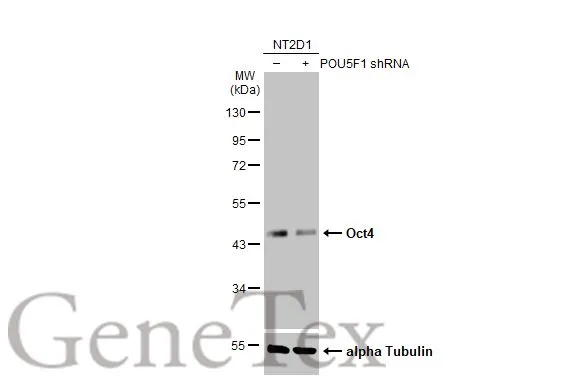
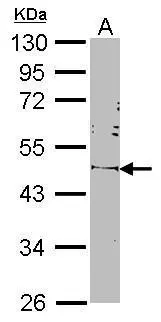
Non-transfected (–) and transfected (+) NT2D1 whole cell extracts (30 μg) were separated by 10% SDS-PAGE, and the membrane was blotted with Oct4 antibody (GTX101497) diluted at 1:200000. The HRP-conjugated anti-rabbit IgG antibody (GTX213110-01) was used to detect the primary antibody.
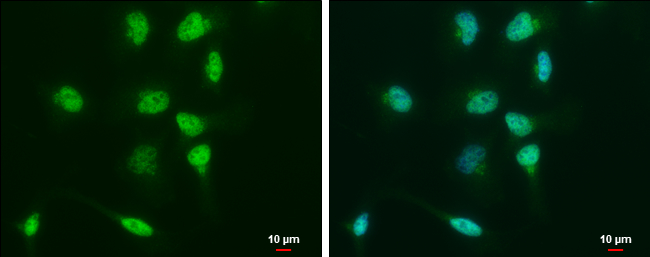
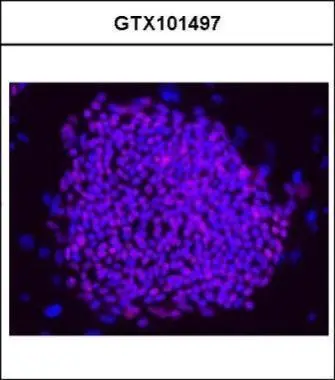
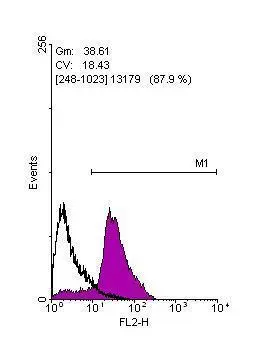
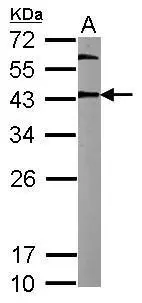
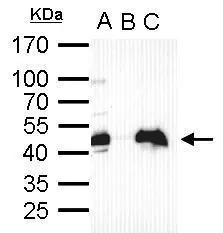
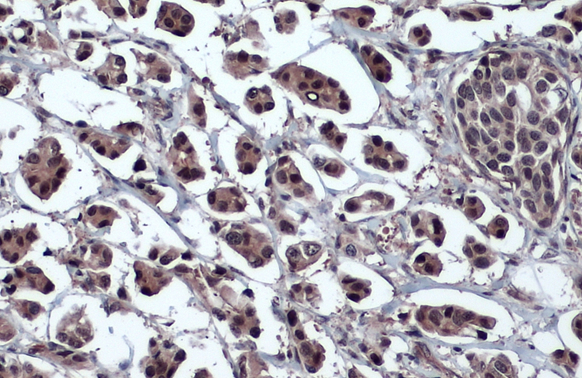
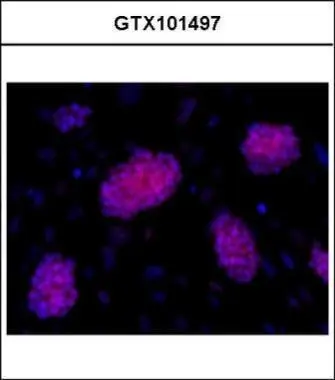
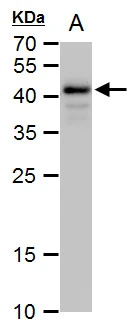
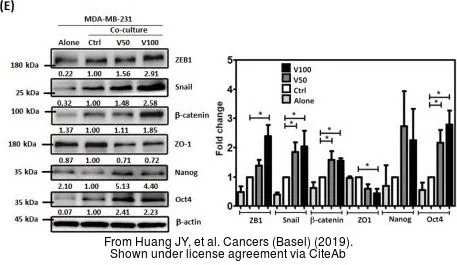
Non-transfected (–) and transfected (+) NT2D1 whole cell extracts (30 μg) were separated by 10% SDS-PAGE, and the membrane was blotted with Oct4 antibody (GTX101497) diluted at 1:200000. The HRP-conjugated anti-rabbit IgG antibody (GTX213110-01) was used to detect the primary antibody.
Oct4 antibody
GTX101497

ApplicationsFlow Cytometry, ImmunoFluorescence, ImmunoPrecipitation, Western Blot, ImmunoCytoChemistry, ImmunoHistoChemistry, ImmunoHistoChemistry Frozen, ImmunoHistoChemistry Paraffin
Product group Antibodies
ReactivityHuman, Mouse, Rat
TargetPOU5F1
Overview
- SupplierGeneTex
- Product NameOct4 antibody
- Delivery Days Customer9
- Application Supplier NoteWB: 1:5000-1:100000. ICC/IF: 1:100-1:1000. IHC-P: 1:100-1:1000. FACS: 1:50-1:200. IP: 1:500-1:1000. *Optimal dilutions/concentrations should be determined by the researcher.Not tested in other applications.
- ApplicationsFlow Cytometry, ImmunoFluorescence, ImmunoPrecipitation, Western Blot, ImmunoCytoChemistry, ImmunoHistoChemistry, ImmunoHistoChemistry Frozen, ImmunoHistoChemistry Paraffin
- CertificationResearch Use Only
- ClonalityPolyclonal
- Concentration1 mg/ml
- ConjugateUnconjugated
- Gene ID5460
- Target namePOU5F1
- Target descriptionPOU class 5 homeobox 1
- Target synonymsOCT3, OCT4, OCT4Borf1, OTF-3, OTF3, OTF4, Oct-3, Oct-4, Oct3/4, POU domain, class 5, transcription factor 1, POU domain transcription factor OCT4, POU-type homeodomain-containing DNA-binding protein, octamer-binding protein 3, octamer-binding protein 4, octamer-binding transcription factor 3
- HostRabbit
- IsotypeIgG
- Protein IDQ01860
- Protein NamePOU domain, class 5, transcription factor 1
- Scientific DescriptionThis gene encodes a transcription factor containing a POU homeodomain. This transcription factor plays a role in embryonic development, especially during early embryogenesis, and it is necessary for embryonic stem cell pluripotency. A translocation of this gene with the Ewings sarcoma gene, t(6;22)(p21;q12), has been linked to tumor formation. Alternative splicing, as well as usage of alternative translation initiation codons, results in multiple isoforms, one of which initiates at a non-AUG (CUG) start codon. Related pseudogenes have been identified on chromosomes 1, 3, 8, 10, and 12. [provided by RefSeq]
- ReactivityHuman, Mouse, Rat
- Storage Instruction-20°C or -80°C,2°C to 8°C
- UNSPSC12352203
References
- Tsai YF, Chan LP, Chen YK, et al. RAD51 is a poor prognostic marker and a potential therapeutic target for oral squamous cell carcinoma. Cancer Cell Int. 2023,23(1):231. doi: 10.1186/s12935-023-03071-wRead this paper
- Wang CH, Huang YF, Shyu WC, et al. Cbx7 promotes the generation of induced pluripotent stem cells. Regen Ther. 2023,24:443-450. doi: 10.1016/j.reth.2023.09.008Read this paper
- Cardile A, Passarini C, Zanrè V, et al. Hyperforin Enhances Heme Oxygenase-1 Expression Triggering Lipid Peroxidation in BRAF-Mutated Melanoma Cells and Hampers the Expression of Pro-Metastatic Markers. Antioxidants (Basel). 2023,12(7). doi: 10.3390/antiox12071369Read this paper
- Ye P, Chi X, Yan X, et al. Alanine-Glyoxylate Aminotransferase Sustains Cancer Stemness Properties through the Upregulation of SOX2 and OCT4 in Hepatocellular Carcinoma Cells. Biomolecules. 2022,12(5). doi: 10.3390/biom12050668Read this paper
- Zhang W, Li Y, Wang L, et al. Generation of a DKK2 homozygous knockout human embryonic stem cell line using the CRISPR/Cas9 system. Stem Cell Res. 2021,57:102611. doi: 10.1016/j.scr.2021.102611Read this paper
- Mohankumar K, Shrestha R, Safe S. Nuclear receptor 4A1 (NR4A1) antagonists target paraspeckle component 1 (PSPC1) in cancer cells. Mol Carcinog. 2022,61(1):73-84. doi: 10.1002/mc.23362Read this paper
- Salti A, Etemad S, Cubero MS, et al. High Glycolytic Activity Enhances Stem Cell Reprogramming of Fahd1-KO Mouse Embryonic Fibroblasts. Cells. 2021,10(8). doi: 10.3390/cells10082040Read this paper
- He Q, Song J, Cui C, et al. Mesenchymal stem cell-derived exosomal miR-146a reverses diabetic β-cell dedifferentiation. Stem Cell Res Ther. 2021,12(1):449. doi: 10.1186/s13287-021-02371-0Read this paper
- Wang YY, Chen HD, Lo S, et al. Visfatin Enhances Breast Cancer Progression through CXCL1 Induction in Tumor-Associated Macrophages. Cancers (Basel). 2020,12(12). doi: 10.3390/cancers12123526Read this paper
- Fang W, Ni M, Zhang M, et al. Prognostic value of OCT4 in colorectal cancer: analysis using immunohistochemistry and bioinformatics validation. Biomark Med. 2020,14(15):1473-1484. doi: 10.2217/bmm-2020-0069Read this paper
Datasheet
Related products
Product group Antibodies

Anti-Oct3/4 [41B1]Ab03310-10.0
ApplicationsWestern Blot, ImmunoHistoChemistry
ReactivityHuman
TargetPOU5F1
- SizePrice
Product group Antibodies

Anti-POU5F1 Antibody144-07920
ApplicationsImmunoFluorescence, Western Blot, ImmunoHistoChemistry
ReactivityHuman, Mouse, Rat
TargetPOU5F1
- SizePrice


Product group Antibodies

Anti-Oct4/POU5F1 Antibody Picoband(r)A00174-1-CARRIER-FREE
ApplicationsFlow Cytometry, Western Blot, ELISA
ReactivityHuman, Mouse, Rat
TargetPOU5F1
- SizePrice
Product group Antibodies
References
Oct4 antibodyGTX100468
ApplicationsFlow Cytometry, ImmunoFluorescence, ImmunoPrecipitation, Western Blot, ImmunoCytoChemistry
ReactivityAmphibian, Human
TargetPOU5F1
- SizePrice
Product group Antibodies
References
Oct4 antibodyGTX100622
ApplicationsFlow Cytometry, ImmunoFluorescence, ImmunoPrecipitation, Western Blot, ImmunoCytoChemistry
ReactivityHuman, Mouse
TargetPOU5F1
- SizePrice
Product group Antibodies
Oct4 antibody [N2C3]GTX100855
ApplicationsWestern Blot
ReactivityHuman, Mouse
TargetPOU5F1
- SizePrice
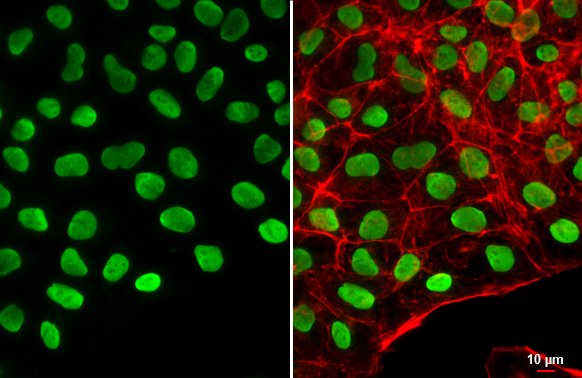
![Oct4 antibody [GT486] detects Oct4 protein at nucleus by immunofluorescent analysis. Sample: NT2D1 cells were fixed in 4% paraformaldehyde at RT for 15 min. Green: Oct4 stained by Oct4 antibody [GT486] (GTX627419) diluted at 1:500. Red: beta Tubulin, a cytoskeleton marker, stained by beta Tubulin antibody (GTX101279) diluted at 1:1000.](https://www.genetex.com/upload/website/prouct_img/normal/GTX627419/GTX627419_43990_20230421_ICC_IF_23050918_155.webp)
Product group Antibodies
References
Oct4 antibody [GT486]GTX627419
ApplicationsFlow Cytometry, ImmunoFluorescence, ImmunoPrecipitation, Western Blot, ImmunoCytoChemistry, ImmunoHistoChemistry, ImmunoHistoChemistry Paraffin
ReactivityHuman, Mouse
TargetPOU5F1
- SizePrice
![Non-transfected (–) and transfected (+) NT2D1 whole cell extracts (30 μg) were separated by 10% SDS-PAGE, and the membrane was blotted with Oct4 antibody [GT735] (GTX627423) diluted at 1:2000. The HRP-conjugated anti-mouse IgG antibody (GTX213111-01) was used to detect the primary antibody.](https://www.genetex.com/upload/website/prouct_img/normal/GTX627423/GTX627423_40980_20210723_WB_shRNA_watermark_w_23061202_871.webp)
Product group Antibodies
Oct4 antibody [GT735]GTX627423
ApplicationsFlow Cytometry, ImmunoFluorescence, ImmunoPrecipitation, Western Blot, ImmunoCytoChemistry
ReactivityHuman
TargetPOU5F1
- SizePrice