

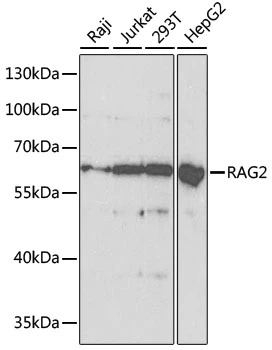
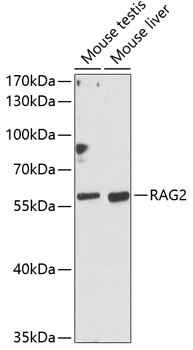
WB analysis of various sample lysates using GTX54683 RAG2 antibody. Dilution : 1:1000 Loading : 25μg per lane
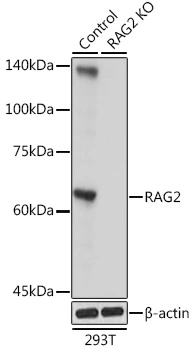
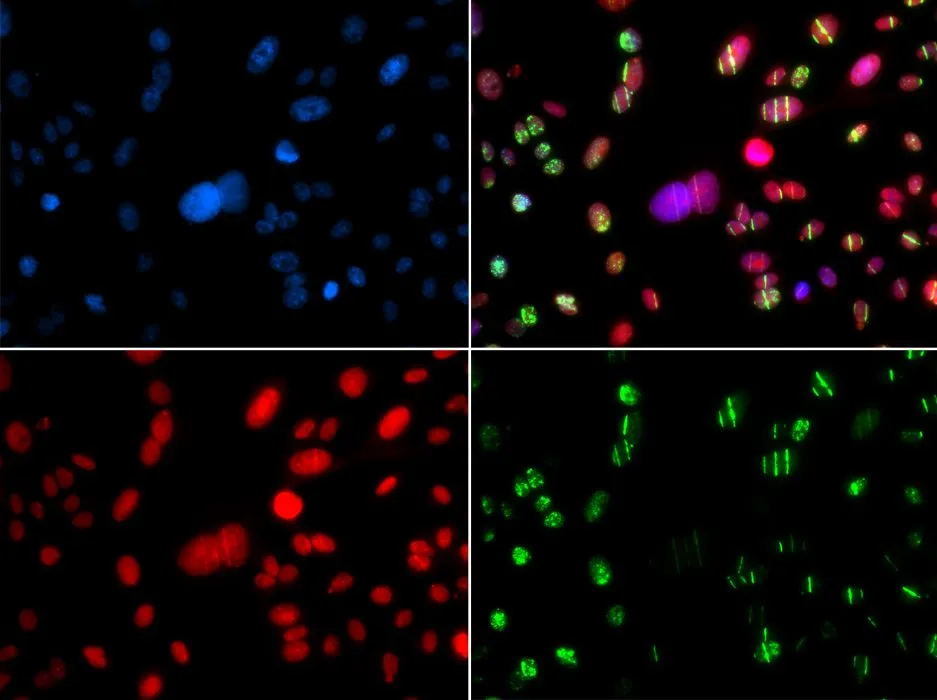
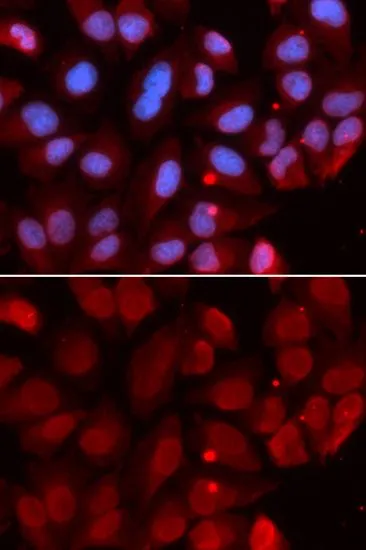
WB analysis of various sample lysates using GTX54683 RAG2 antibody. Dilution : 1:1000 Loading : 25μg per lane
RAG2 antibody
GTX54683

ApplicationsImmunoFluorescence, Western Blot, ImmunoCytoChemistry
Product group Antibodies
ReactivityHuman
TargetRAG2
Overview
- SupplierGeneTex
- Product NameRAG2 antibody
- Delivery Days Customer7
- Application Supplier NoteWB: 1:500 - 1:2000. ICC/IF: 1:50 - 1:200. *Optimal dilutions/concentrations should be determined by the researcher.Not tested in other applications.
- ApplicationsImmunoFluorescence, Western Blot, ImmunoCytoChemistry
- CertificationResearch Use Only
- ClonalityPolyclonal
- ConjugateUnconjugated
- Gene ID5897
- Target nameRAG2
- Target descriptionrecombination activating 2
- Target synonymsRAG-2, V(D)J recombination-activating protein 2, recombination activating gene 2
- HostRabbit
- IsotypeIgG
- Protein IDP55895
- Protein NameV(D)J recombination-activating protein 2
- Scientific DescriptionThis gene encodes a protein that is involved in the initiation of V(D)J recombination during B and T cell development. This protein forms a complex with the product of the adjacent recombination activating gene 1, and this complex can form double-strand breaks by cleaving DNA at conserved recombination signal sequences. The recombination activating gene 1 component is thought to contain most of the catalytic activity, while the N-terminal of the recombination activating gene 2 component is thought to form a six-bladed propeller in the active core that serves as a binding scaffold for the tight association of the complex with DNA. A C-terminal plant homeodomain finger-like motif in this protein is necessary for interactions with chromatin components, specifically with histone H3 that is trimethylated at lysine 4. Mutations in this gene cause Omenn syndrome, a form of severe combined immunodeficiency associated with autoimmune-like symptoms. [provided by RefSeq, Jul 2008]
- ReactivityHuman
- Storage Instruction-20°C or -80°C,2°C to 8°C
- UNSPSC41116161
Datasheet
Related products


Product group Antibodies

Anti-RAG2 Antibody144-62349
ApplicationsWestern Blot
ReactivityHuman, Mouse
TargetRAG2
- SizePrice
Product group Antibodies

RAG2 / RAG-2 AntibodyLS-C747587
ApplicationsWestern Blot
ReactivityHuman, Mouse
TargetRAG2
- SizePrice
Product group Antibodies

RAG2 Polyclonal AntibodyBS-6960R
ApplicationsImmunoFluorescence, ELISA, ImmunoCytoChemistry, ImmunoHistoChemistry, ImmunoHistoChemistry Frozen, ImmunoHistoChemistry Paraffin
ReactivityBovine, Canine, Equine, Human, Mouse, Porcine, Rabbit, Rat, Sheep
TargetRAG2
- SizePrice

Product group Antibodies

Anti-RAG2 Antibody Picoband(r)A00352-CARRIER-FREE
ApplicationsFlow Cytometry, Western Blot, ELISA
ReactivityHuman, Mouse
TargetRAG2
- SizePrice
Product group Antibodies

RAG2 AntibodyCSB-PA345128LA01HU
ApplicationsImmunoFluorescence, ELISA
ReactivityHuman
TargetRAG2
- SizePrice
![WB analysis of RAG2(AA: 350-527)-hIgGFc transfectedHEK293 cell lysate using GTX83284 RAG2 antibody [4D5].](https://www.genetex.com/upload/website/prouct_img/normal/GTX83284/GTX83284_20170912_WB_w_23061322_274.webp)
Product group Antibodies
RAG2 antibody [4D5]GTX83284
ApplicationsWestern Blot, ELISA
ReactivityHuman
TargetRAG2
- SizePrice

Product group Antibodies

Anti-RAG2 AntibodyHPA065704
ApplicationsImmunoCytoChemistry
ReactivityHuman
TargetRAG2
- SizePrice
Product group Antibodies
RAG2 antibodyGTX109710
ApplicationsImmunoFluorescence, Western Blot, ImmunoCytoChemistry, ImmunoHistoChemistry, ImmunoHistoChemistry Paraffin
ReactivityHuman, Rat
TargetRAG2
- SizePrice