

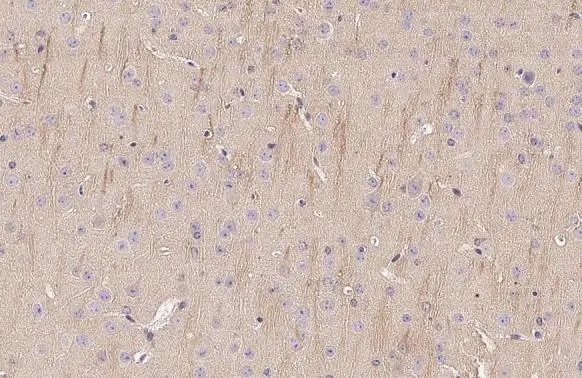
VRL1 antibody [HL1543] detects VRL1 protein by immunohistochemical analysis. Sample: Paraffin-embedded mouse brain. VRL1 stained by VRL1 antibody [HL1543] (GTX637018) diluted at 1:100. Antigen Retrieval: Citrate buffer, pH 6.0, 15 min
![Unboiled K562 whole cell and membrane extracts (30 μg) were separated by 5% SDS-PAGE, and the membrane was blotted with VRL1 antibody [HL1543] (GTX637018) diluted at 1:2000. The HRP-conjugated anti-rabbit IgG antibody (GTX213110-01) was used to detect the primary antibody, and the signal was developed with Trident ECL plus-Enhanced. (WCE: whole cell extract; ME: membrane extract)](https://www.genetex.com/upload/website/prouct_img/normal/GTX637018/GTX637018_44928_20230120_WB_Fraction_23021401_416.webp "Unboiled K562 whole cell and membrane extracts (30 μg) were separated by 5% SDS-PAGE, and the membrane was blotted with VRL1 antibody [HL1543] (GTX637018) diluted at 1:2000. The HRP-conjugated anti-rabbit IgG antibody (GTX213110-01) was used to detect the primary antibody, and the signal was developed with Trident ECL plus-Enhanced. (WCE: whole cell extract; ME: membrane extract)")
![VRL1 antibody [HL1543] detects VRL1 protein at fiber by immunofluorescent analysis. Sample: DIV9 rat E18 primary hippocampal neuron cells were fixed in 4% paraformaldehyde at RT for 15 min. Green: VRL1 stained by VRL1 antibody [HL1543] (GTX637018) diluted at 1:250. Blue: Fluoroshield with DAPI (GTX30920).](https://www.genetex.com/upload/website/prouct_img/normal/GTX637018/GTX637018_T-44697_20230519_ICC_IF_R_23053001_873.webp "VRL1 antibody [HL1543] detects VRL1 protein at fiber by immunofluorescent analysis. Sample: DIV9 rat E18 primary hippocampal neuron cells were fixed in 4% paraformaldehyde at RT for 15 min. Green: VRL1 stained by VRL1 antibody [HL1543] (GTX637018) diluted at 1:250. Blue: Fluoroshield with DAPI (GTX30920).")
![VRL1 antibody [HL1543] detects VRL1 protein at cell membrane and cytoplasm by immunofluorescent analysis. Sample: K562 cells were fixed in 4% paraformaldehyde at RT for 15 min. Green: VRL1 stained by VRL1 antibody [HL1543] (GTX637018) diluted at 1:500. Blue: Fluoroshield with DAPI (GTX30920).](https://www.genetex.com/upload/website/prouct_img/normal/GTX637018/GTX637018_44928_20230526_ICC_IF_23060622_760.webp "VRL1 antibody [HL1543] detects VRL1 protein at cell membrane and cytoplasm by immunofluorescent analysis. Sample: K562 cells were fixed in 4% paraformaldehyde at RT for 15 min. Green: VRL1 stained by VRL1 antibody [HL1543] (GTX637018) diluted at 1:500. Blue: Fluoroshield with DAPI (GTX30920).")
VRL1 antibody [HL1543] detects VRL1 protein by immunohistochemical analysis. Sample: Paraffin-embedded mouse brain. VRL1 stained by VRL1 antibody [HL1543] (GTX637018) diluted at 1:100. Antigen Retrieval: Citrate buffer, pH 6.0, 15 min
VRL1 antibody [HL1543]
GTX637018

ApplicationsImmunoFluorescence, Western Blot, ImmunoCytoChemistry, ImmunoHistoChemistry, ImmunoHistoChemistry Paraffin
Product group Antibodies
ReactivityHuman, Mouse, Rat
TargetTRPV2
Overview
- SupplierGeneTex
- Product NameVRL1 antibody [HL1543]
- Delivery Days Customer9
- Application Supplier NoteWB: 1:500-1:3000. *Optimal dilutions/concentrations should be determined by the researcher.Not tested in other applications.
- ApplicationsImmunoFluorescence, Western Blot, ImmunoCytoChemistry, ImmunoHistoChemistry, ImmunoHistoChemistry Paraffin
- CertificationResearch Use Only
- ClonalityMonoclonal
- Clone IDHL1543
- Concentration1 mg/ml
- ConjugateUnconjugated
- Gene ID51393
- Target nameTRPV2
- Target descriptiontransient receptor potential cation channel subfamily V member 2
- Target synonymsVRL, VRL-1, VRL1, transient receptor potential cation channel subfamily V member 2, OTRPC2, osm-9-like TRP channel 2, vanilloid receptor-like protein 1
- HostRabbit
- IsotypeIgG
- Protein IDQ9Y5S1
- Protein NameTransient receptor potential cation channel subfamily V member 2
- Scientific DescriptionThis gene encodes an ion channel that is activated by high temperatures above 52 degrees Celsius. The protein may be involved in transduction of high-temperature heat responses in sensory ganglia. It is thought that in other tissues the channel may be activated by stimuli other than heat. [provided by RefSeq, Jul 2008]
- ReactivityHuman, Mouse, Rat
- Storage Instruction-20°C or -80°C,2°C to 8°C
- UNSPSC41116161
Datasheet
Related products
Product group Antibodies

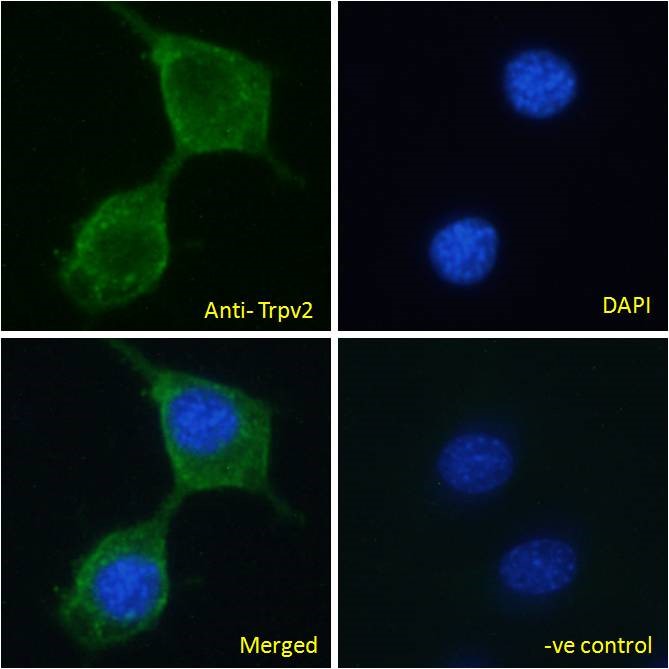
Anti-TRPV2 AntibodyA84565
ApplicationsImmunoFluorescence, ELISA
ReactivityMouse
- SizePrice

Product group Antibodies

Anti-VRL1/TRPV2 Antibody Picoband(r)A02786-3-CARRIER-FREE
ApplicationsFlow Cytometry, Western Blot, ELISA
ReactivityHuman, Mouse, Rat
TargetTRPV2
- SizePrice
Product group Antibodies

VRL1 / TRPV2 AntibodyLS-C747475
ApplicationsWestern Blot
ReactivityHuman
TargetTRPV2
- SizePrice


Product group Antibodies

Anti-TRPV2 AntibodyHPA044993
ApplicationsImmunoCytoChemistry, ImmunoHistoChemistry
ReactivityHuman
TargetTRPV2
- SizePrice
Product group Antibodies

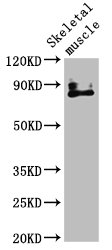
TRPV2 AntibodyCSB-PA897571LA01HU
ApplicationsImmunoFluorescence, Western Blot, ELISA, ImmunoHistoChemistry
ReactivityHuman, Mouse
TargetTRPV2
- SizePrice
Product group Antibodies

Trpv2 Polyclonal AntibodyCAC11366
ApplicationsImmunoFluorescence, Western Blot, ELISA, ImmunoHistoChemistry
ReactivityMouse
TargetTRPV2
- SizePrice
![Unboiled K562 whole cell and membrane extracts (30 μg) were separated by 5% SDS-PAGE, and the membrane was blotted with VRL1 antibody [C2C3], C-term (GTX101868) diluted at 1:500. The HRP-conjugated anti-rabbit IgG antibody (GTX213110-01) was used to detect the primary antibody. (WCE: whole cell extract; ME: membrane extract)](https://www.genetex.com/upload/website/prouct_img/normal/GTX101868/GTX101868_44468_20211126_WB_Fraction_w_23060100_508.webp)
Product group Antibodies
VRL1 antibody [C2C3], C-termGTX101868
ApplicationsWestern Blot, ImmunoHistoChemistry, ImmunoHistoChemistry Paraffin
ReactivityHuman
TargetTRPV2
- SizePrice
Product group Antibodies

Anti-TRPV2 (N-term) Antibody102-21699
ApplicationsWestern Blot
TargetTRPV2
- SizePrice